
Furniture cut-list designer — 3D preview and SketchUp export
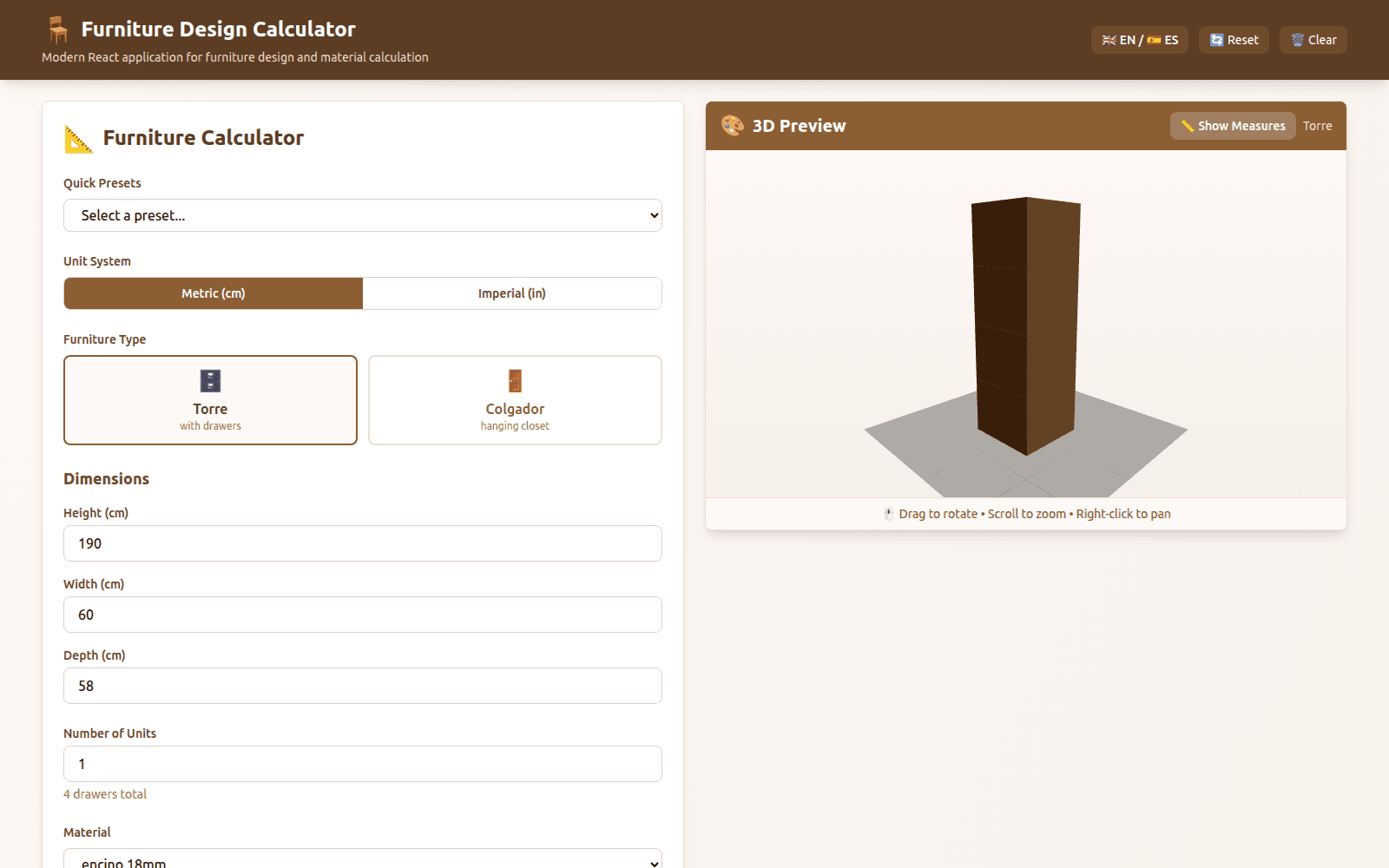
A browser tool that turns wardrobe dimensions into an exact cut list, a live 3D model and a ready-to-run SketchUp script — replacing two Python scripts the workshop ran by hand on one machine.
- Role
- Full-stack engineer
- Timeline
- Delivered as a standalone web app
- Stack
- React 18 · TypeScript · Vite · Three.js · React Three Fiber · Tailwind CSS · Cloudflare Pages
A live system in daily operation for waste-management ticket intake — this page embeds the running demo.
What was broken
The workshop sized every wardrobe by hand. Two Python scripts — one for the cut list, one that emitted a SketchUp model — lived on a single machine and could only be run by the person who wrote them. Everyone else worked from a spreadsheet and a tape measure, and a mis-typed panel width is a ruined board.
How it was fixed
Ported both Python scripts to typed TypeScript, preserving the cut formulas exactly rather than rewriting them, so the shop's numbers stayed the shop's numbers. Added a React Three Fiber viewport that rebuilds the piece live as dimensions change, with toggleable measurement overlays. The Ruby generator emits a script that models the whole unit inside SketchUp — copy to clipboard or download as a .rb file. Metric/imperial conversion, five 18 mm board materials, a preset library for the two standard units, EN/ES throughout, and localStorage so a half-finished design survives a refresh.
Constraints
- The existing formulas were non-negotiable: −1.8 cm on height, −3.6 cm on width and 18 mm board thickness encode how the shop actually cuts and assembles.
- The shop measures in centimetres, but imported hardware and client drawings arrive in inches.
- Output had to land in SketchUp, the tool the workshop already models in — not a proprietary format.
Tools in the system
- React 18
- TypeScript
- Vite
- Three.js
- React Three Fiber
- Tailwind CSS
- Cloudflare Pages
What changed
Dimensions go in; an exact cut list, a rotatable 3D model and a SketchUp script come out — in either language and either unit system. The calculation that lived in one person's Python scripts is now a link anyone in the shop can open on any device.
What carries forward
- 01Porting a trusted calculation means preserving its constants verbatim — the −1.8 and −3.6 cm adjustments are shop knowledge, not magic numbers to clean up.
- 02A live 3D preview catches proportion mistakes that a table of numbers hides completely.
- 03Exporting into the tool someone already uses beats any format of your own, however good.
Related case studies
All work- Web & Commerce · 2026El Refugio — vacation-rental booking with card & crypto paymentsA production booking site for a Playa del Carmen rental owner: guests pay by debit/credit card or cryptocurrency, and availability stays in sync with Airbnb.
- Web & Commerce · 2026SPUMABEAT — foam-party & event-production websiteA production marketing and booking site for the original foam-party company in the Riviera Maya: service catalog, blog, gallery, and a quote funnel served from a small self-hosted box.